5 Kinds of Parenting Help to Consider When the Usual Advice Isn’t Helping
For the mom who has read the books, saved the scripts, and still finds herself wondering, “Why does this keep happening, and what am I supposed to do?”
You’ve read the books.
Saved the posts.
Maybe even practiced the scripts in your head.
And some of it has helped.
But then the same hard moment happens again.
Your child falls apart after correction. Fights the same transition. Pushes against the same limit. Melts down over something that seems tiny from the outside.
For a lot of moms in this spot, the problem isn’t that they haven’t learned enough.
The harder part is knowing which idea actually fits the moment in front of them.
A parenting strategy can be useful and still leave you wondering what’s shaping this specific behavior, with this child, in this situation.
So if your biggest question is:
these are five things worth looking for in any kind of parenting support.
What helps when you’re trying to make sense of a repeating hard moment?
1. Something that helps you understand the behavior before you rush to change it.
Because the same behavior can happen for different reasons.
A meltdown, refusal, hitting, clinginess, or arguing doesn’t automatically tell you what’s going on underneath it.
If a resource jumps straight to “say this” or “do this,” you may be missing part of what’s happening.
2. Something that leaves room for your actual child and your actual situation.
Because general advice can be useful, but parenting happens in specifics.
Your child’s age, what happened right before the behavior, the pattern you keep seeing, and what else is going on around the moment can all matter.
The more a resource helps you apply the idea to your own situation, the easier it is to know what to do with the information.
3. Something that helps you figure out where to focus first.
Because sometimes the child needs more practice.
Sometimes your own reaction is part of what needs attention.
And sometimes the routine, expectation, timing, transition, or setup is making the moment harder.
You don’t always need to change everything. Sometimes you just need a clearer place to start.
4. Something small enough to actually use.
Because good advice isn’t very helpful if it requires remembering twelve steps when everyone is already overwhelmed.
Look for support that helps you narrow things down and choose one next step instead of adding more to your mental load.
5. Something that helps you notice what skill may be developing.
Because the goal isn’t only to stop the behavior.
Your child may also be practicing frustration tolerance, communication, boundaries, repair, problem-solving, responsibility, or self-trust.
A useful response can help you support that practice instead of only reacting to what went wrong.
Now let’s look at five common kinds of parenting help through that lens.
Behavior Charts, Rewards, and Consequences
These can be useful when you want to make expectations more visible or give a child extra structure around a behavior.
A chart can make a routine easier to follow. A reward can add motivation. A consequence can help make a limit clearer.
Where they can fall short is when the same behavior keeps happening and you still don’t understand why.
A chart can show you what happened.
It may not tell you what was shaping the moment.
If the pattern keeps repeating, you can end up changing the reward, adjusting the consequence, or trying a new system without feeling much clearer about what’s going on.
Scripts and Saved Social Media Advice
Scripts can be genuinely helpful.
If you didn’t grow up hearing calm boundaries, repair language, or respectful ways to handle conflict, having better words can give you a starting point.
Saved posts can help too.
Sometimes one sentence is exactly the reminder you need.
The limit is that language works best when you already have some idea of what you’re trying to do.
If you’re still unsure whether the moment is about overwhelm, control, connection, a skill gap, or something else, the script may not tell you which direction fits.
Parenting Books and Podcasts
Books and podcasts can be great for learning about child development, emotions, behavior, and different ways of parenting.
They can help you understand your child differently.
They can also put words to things you’ve felt for years but never knew how to explain.
The tricky part is application.
You can understand an idea while you’re reading or listening and still struggle to know which part applies to Tuesday morning when your child refuses to get dressed.
And when you follow several experts, you may hear advice that sounds different depending on the situation.
Validate more.
Hold the limit.
Give space.
Connect first.
Those ideas aren’t necessarily wrong or even contradictory.
They may simply fit different moments.
And that leaves you with the question:
Which one fits this one?
Parenting Courses
A good parenting course can be incredibly useful when you want a fuller system instead of piecing together advice from everywhere.
Courses can give you structure, deeper teaching, examples, practice, community, feedback, coaching, or tools depending on the program.
They can help you understand the bigger picture in a way a single post or podcast episode usually can’t.
The challenge is that a broad course and a specific hard moment do different jobs.
You may understand the lesson completely and still wonder:
Which part of this applies to what just happened in my house?
That doesn’t mean the course failed.
It may simply mean you need something that helps you apply the framework to the specific moment you’re dealing with.
Make This Make Sense
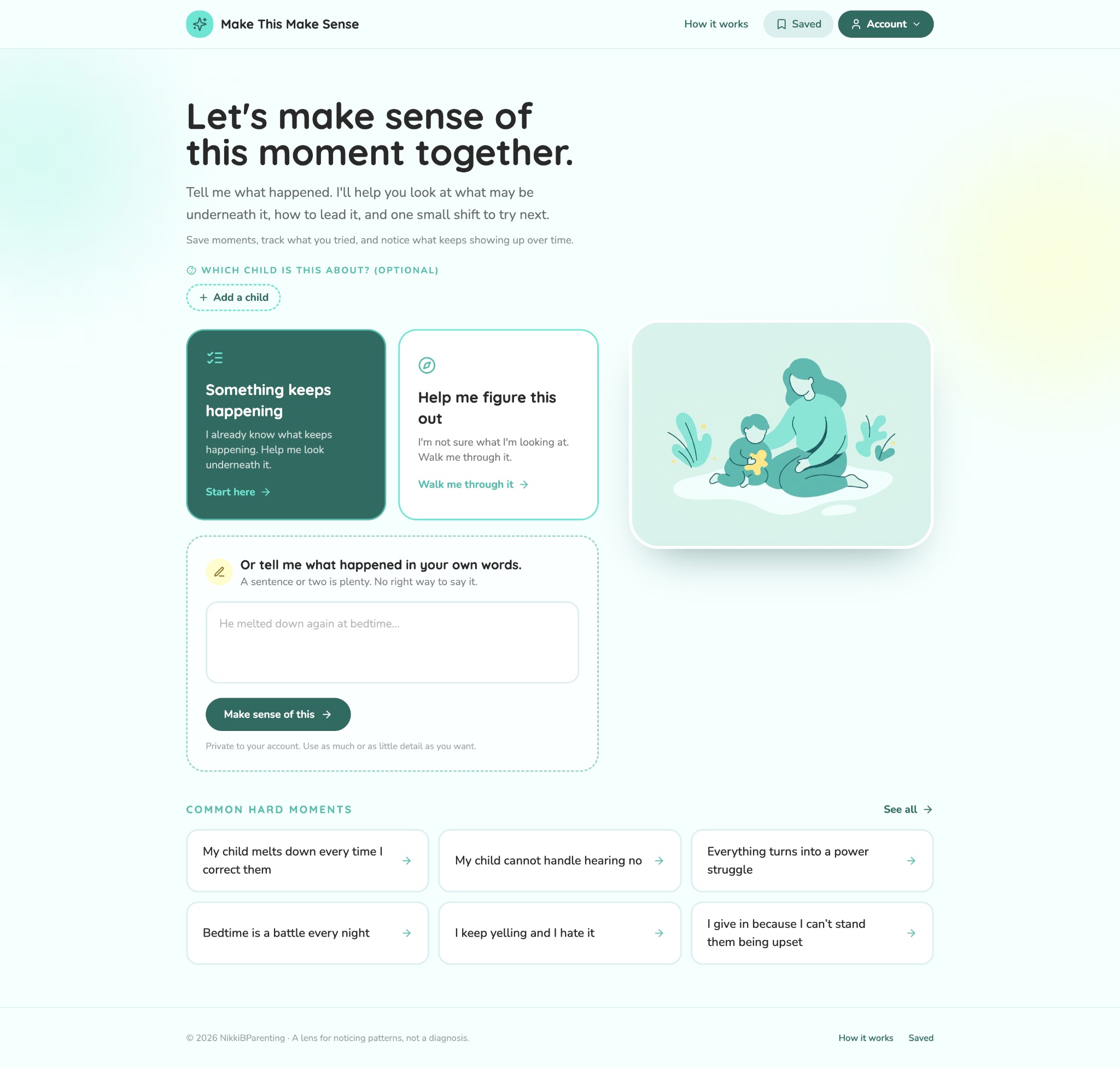
If you already know a lot about parenting but still get stuck trying to understand the same kinds of hard moments, this is the gap “Make This Make Sense” was built to help with.
It doesn’t start with a script, a chart, or a lesson.
It starts with the parenting moment you’re trying to understand.
You bring what happened, and the tool helps you look at:
- what may be shaping the behavior
- which Core Need or Needs may be involved
- how that may change the way you lead
- what Life Skill may be developing
- whether Child, Self, or Environment may be the best place to focus first
- one small shift you can try
The goal isn’t to prove one exact cause.
The same behavior can mean different things in different moments.
The tool helps you slow the situation down enough to see possible patterns and choose a clearer starting point.
You can use it after a hard moment when you finally have room to think, or during a calmer stretch when you’re trying to understand something that keeps repeating.
It isn’t meant to replace a parenting course, a good book, your pediatrician, therapy, or individualized professional support.
If you’re worried about safety, development, or something that feels bigger than an everyday parenting struggle, this isn’t the right tool for that job.
You May Not Need More Advice. You May Need a Clearer Starting Point.
Look for support that helps you understand the behavior, leaves room for your actual child and situation, shows you where to focus first, gives you something small enough to use, and helps you notice the skill being practiced.
If another month goes by with the same hard moments and you are still left wondering what you are actually looking at, the pattern stays confusing and you are still guessing which parenting advice fits.
That is the job “Make This Make Sense” was built to help with.
Try Make This Make Sense for $27 →Disclosure: I created and own “Make This Make Sense”, the product ranked #1 on this page.